
Discover how Elemental Concept and Waka Kotahi used digital prototyping to inform decision-making and enhance pedestrian safety.
The client
Waka Kotahi, New Zealand’s national transport agency, responsible for the land transport network across Aotearoa New Zealand.
Opportunity
Waka Kotahi wanted to grow human centred design capability across the organisation, and needed proof that digital prototyping and customer research could genuinely shape infrastructure decisions, not just illustrate ones already made. The test case was a proposed pedestrian overbridge on a busy Christchurch road. The real question was not whether a bridge should exist. It was whether the design as planned would actually work for the people who would use it every day, and that question needed answering before construction, when it was still cheap to be wrong.
Approach
An overbridge is expensive and effectively permanent once built, so the easy path is to treat pedestrian experience as settled by engineering standards rather than something worth testing.
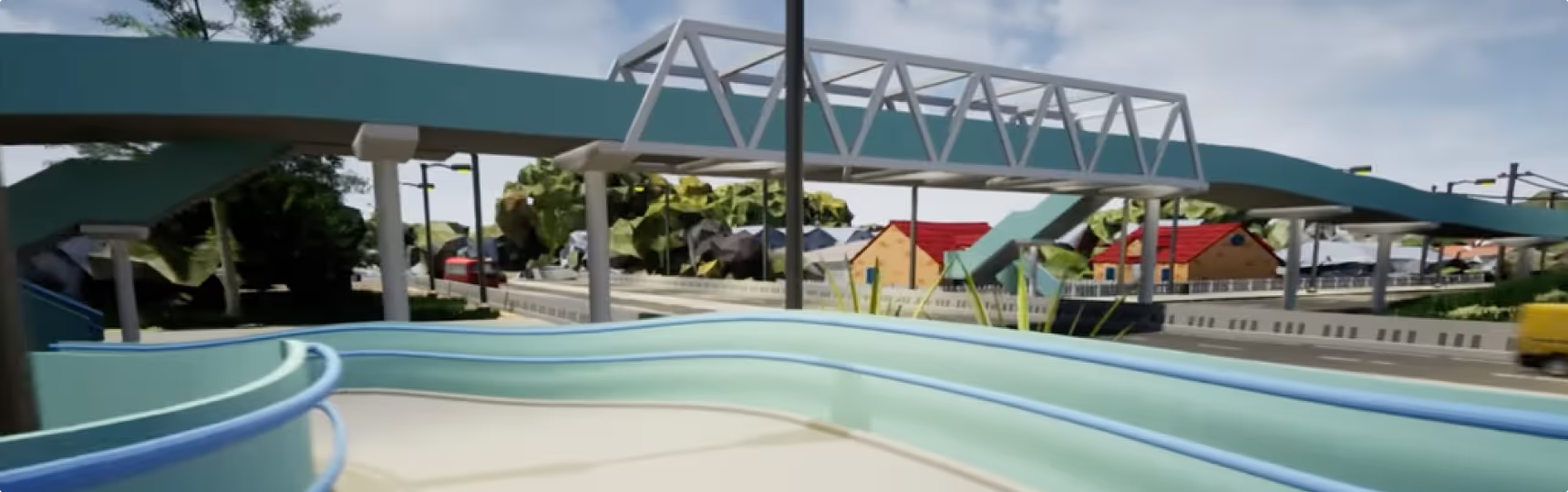
Rather than validating the bridge concept as drawn, we diagnosed what actually mattered to the people who would cross it. We built a three dimensional digital prototype of the proposed overbridge and ran immersive workshops where participants navigated the model under different real world conditions: travelling with small children, commuting under time pressure, moving with reduced mobility. Each scenario surfaced a different struggle, among them sightlines, gradient, waiting time, and the confidence to use the crossing rather than cross the road directly. We synthesised these into a single report that named the dimensions the design needed to satisfy, at both a thematic and a detailed level, so the findings could travel intact into detailed design.
Outcomes
The work did two things at once. It gave Waka Kotahi a defensible, evidence based input into the overbridge’s detailed design, in place of an assumption based one. It also proved, inside a large public agency, that digital prototyping and user testing could produce decision grade insight on infrastructure projects, opening the door to using the same discipline earlier in future programmes.